Over the last few Sundays at CBC we have been recapping and reviewing our Vision. For the next seven Sundays we're going to be looking at our seven Core Values. The Core Values are:
Loving, Welcoming, Missional, Servant-hearted, Biblical, Spirit-led and Prayerful
Whereas a Vision is about a destination - this is what God is calling us to - our Values are about who we are. And so in terms of decision making our Vision helps us by forcing us to ask the question, 'is doing X going to help us in our journey to become ...?' But our Values help us in our decision making process because they force us to reflect on who we are - and it is this knowledge that shapes how we act and respond.
Although these values are not listed in any kind of order of priority it is appropriate that we start with love. Jesus taught his disciples that the whole of the law hangs on two commands - to love God with all your heart, soul, strength and mind; and to love your neighbour as yourself (e.g. Luke 10:25-37).
Later in the New Testament, Paul teaches that no matter how gifted we are, or what we are able to achieve, unless we are acting in love it is all of no more value than the noise of a clanging cymbal (1 Corinthians 13:1-13).
There are many people in today's world who have a very mixed up view of what love looks like. Fortunately, as we read through the gospels we discover what love looks like - in the person of Jesus. God is not just loving - God is love (1 John 4:16).
But this picture of love that we discover in the gospels is both comforting and challenging. It is comforting to know that even though God knows everything there is to know about us Jesus still loved us so much that he was prepared to die on the cross (Romans 5:8).
But it is challenging to know that we are called to love in this totally giving, self-sacrificial way. Demonstrating our love to our enemies as well as our friends.
But this is only possible when we know that we are loved by God. We are only able to love because God has loved us first (1 John 4:19). Everything that we do has to be motivated out of love. Our actions are our response to the love of God that we have already experienced.
So everything that we do and everything that we say is shaped by our knowledge and experience of God's love for us, our love for God and a genuine love for others.
Wednesday, 1 February 2017

Thursday, 5 January 2017
Revisiting our Vision
This Sunday morning here at CBC we're going to begin a new series looking at our Vision and Values. We spent time working and praying together at the end of 2015 to put a new Vision in place, and this was adopted by the church at the beginning of 2016. But I am aware that although we explored this is some detail here on this blog we have not yet done so on a Sunday morning or in home groups. And also there are quite a few people around in the church now who were not here at the end of 2015 and start of 2016 - so how good have we been at communicating our vision to them?

A vision is not about where we are - but about where we want to be. Our vision states:

A vision is not about where we are - but about where we want to be. Our vision states:
Seeking to be an authentic community of disciples, becoming more like Jesus - walking in step with God, alongside each other and seeing lives transformed.
So, one year in, how are we doing? We have deliberately used the image of a journey - walking - in our Vision. How far have we come in 2016? Are there areas where we're doing well, and others that are still lagging behind? How do the decisions that we will be taking this year fit in with this Vision?
This Sunday we're going to be thinking about what it means to be an authentic community of disciples - walking in step with each other.
If you want to remind yourselves of what we said a year ago start with this link here and then click on the individual words to unpack the Vision in more detail.
Saturday, 24 December 2016
Sunday, 4 December 2016
Which translation?
On Sunday at CBC we were looking at the story of Samson. This is quite a long story and takes up four chapters (Judges 13-16), so we didn't have time to read the whole thing. Hopefully, if you've not done so already, you'll get a chance to read the story through before home groups this week. But, be warned, it's another one of those stories that leave you wondering, 'what is this doing in the Bible?'
One of the themes of this story is to do with eyes. As with many of the stories in Judges this account begins with the comment 'Again Israel did evil in the eyes of the Lord' (Judges 13:1).
Then in chapter 14 we find Samson seeing and wanting a young Philistine woman - he orders his dad, 'get her for me as my wife'.
But the Philistines are the enemy and the people of Israel have been commanded not to intermarry with them (e.g. Deuteronomy 7:3-4). So Samson's parents try to discourage this match - but there's no telling Samson once his eyes have seen and he's set his heart on getting. And then there is a line which the NIV translates, 'she's the right one for me' (14:3).
The ESV's translation of this verse is much closer to the original, 'she is right in my eyes'.
What's more important for Samson? Doing what is right in God's eyes - or doing what is right in his own eyes? It is not until the end of the story when Samson has actually lost his physical eyes that he begins to see things from God's perspective (16:28).
On Sunday we had time to explore this theme of which is more important - doing what is right in God's eyes or doing what looks right in my eyes. But we did not have time to explore potential questions raised about the different translations of this verse in the NIV and ESV. So as promised, here are a few thoughts.

If you want to know a lot more on this subject my go to book is 'How to read the Bible for all its worth' by Fee and Stuart - particularly chapter 2. (I currently have two copies if anyone wants to borrow them - assuming you live locally.)
Unless you can read Hebrew, Greek and Aramaic then you're going to need a Bible translated into a language you can read. When it comes to English Bibles there are lots to choose from - so which one is best?
Well, the answer to that question very much depends on what you want it for.
You might think that a literal, 'word for word' translation would be best. But if you've studied another language you will be aware that sentence structure and word order are not always the same as they are in English. Also, words do not always translate simply into another word. And figures of speech that were commonplace and understood in First Century Jerusalem simply make no sense to us today. So whilst such a translation might be faithful to the literal text it may be difficult to read (particularly out loud) and hard to understand.
Another approach taken to Bible translation is therefore 'thought for thought' rather than 'word for word'. This approach looks to communicate the meaning of the original but is not restricted to use the original words. These versions are often easier to read and understand, but sometimes mean that we miss links (such as the use of 'eye' in Judges 13:1 and 14:3).
(Sometimes 'word for word' and 'thought for thought' are called 'formal equivalence' and 'dynamic equivalence' respectively.)
At the opposite end of the spectrum to 'word for word' is the paraphrase. This is very much about telling the overarching story and takes 'thought for thought' to the extreme in that there is very little evidence of the original words or sentence structure in the text. You see this, for example, in the Message, where it is not possible to include verse numbers in the text because the meaning is communicated over a paragraph.
There are many different Bible translations in the English language and they will all fall somewhere on this spectrum. You'll find many charts and diagrams on the internet - here's one from the Olive Tree Blog.

The Bible that a person may choose is often a matter a personal preference and one that you grew up with. Personally, I use the NIV as my 'everyday' Bible.
But, as was demonstrated above, with Judges 14:3, when it comes to Bible study - whether this is personal study (as opposed to devotional daily reading), or preparation for a Bible Study or sermon - it is good to use more than one version - each from a different part of the spectrum.

These days, computer Bible software makes this approach even easier, being able to carry around several Bibles in your pocket, on your phone. This is a screen shot from my iPad on which I use Olive Tree Bible Software making it very easy to switch between and compare versions of the same passage - as well as having easy access to study notes and commentaries.
Another helpful resource is the website Biblegateway which allows you to choose your verse and version and takes you straight there.
Again, which Bibles you actually end up with will often be a matter of personal preference.
When it comes to Bible study, I tend to use the ESV from the more literal end of the spectrum, the NRSV and the NIV from nearer the middle, and the Good News or Message from the paraphrase end.
I hope that helps shed a little light on why there are so many different versions and which ones to use when.
One of the themes of this story is to do with eyes. As with many of the stories in Judges this account begins with the comment 'Again Israel did evil in the eyes of the Lord' (Judges 13:1).
Then in chapter 14 we find Samson seeing and wanting a young Philistine woman - he orders his dad, 'get her for me as my wife'.
But the Philistines are the enemy and the people of Israel have been commanded not to intermarry with them (e.g. Deuteronomy 7:3-4). So Samson's parents try to discourage this match - but there's no telling Samson once his eyes have seen and he's set his heart on getting. And then there is a line which the NIV translates, 'she's the right one for me' (14:3).
The ESV's translation of this verse is much closer to the original, 'she is right in my eyes'.
What's more important for Samson? Doing what is right in God's eyes - or doing what is right in his own eyes? It is not until the end of the story when Samson has actually lost his physical eyes that he begins to see things from God's perspective (16:28).
On Sunday we had time to explore this theme of which is more important - doing what is right in God's eyes or doing what looks right in my eyes. But we did not have time to explore potential questions raised about the different translations of this verse in the NIV and ESV. So as promised, here are a few thoughts.

If you want to know a lot more on this subject my go to book is 'How to read the Bible for all its worth' by Fee and Stuart - particularly chapter 2. (I currently have two copies if anyone wants to borrow them - assuming you live locally.)
Unless you can read Hebrew, Greek and Aramaic then you're going to need a Bible translated into a language you can read. When it comes to English Bibles there are lots to choose from - so which one is best?
Well, the answer to that question very much depends on what you want it for.
You might think that a literal, 'word for word' translation would be best. But if you've studied another language you will be aware that sentence structure and word order are not always the same as they are in English. Also, words do not always translate simply into another word. And figures of speech that were commonplace and understood in First Century Jerusalem simply make no sense to us today. So whilst such a translation might be faithful to the literal text it may be difficult to read (particularly out loud) and hard to understand.
Another approach taken to Bible translation is therefore 'thought for thought' rather than 'word for word'. This approach looks to communicate the meaning of the original but is not restricted to use the original words. These versions are often easier to read and understand, but sometimes mean that we miss links (such as the use of 'eye' in Judges 13:1 and 14:3).
(Sometimes 'word for word' and 'thought for thought' are called 'formal equivalence' and 'dynamic equivalence' respectively.)
At the opposite end of the spectrum to 'word for word' is the paraphrase. This is very much about telling the overarching story and takes 'thought for thought' to the extreme in that there is very little evidence of the original words or sentence structure in the text. You see this, for example, in the Message, where it is not possible to include verse numbers in the text because the meaning is communicated over a paragraph.
There are many different Bible translations in the English language and they will all fall somewhere on this spectrum. You'll find many charts and diagrams on the internet - here's one from the Olive Tree Blog.

The Bible that a person may choose is often a matter a personal preference and one that you grew up with. Personally, I use the NIV as my 'everyday' Bible.
But, as was demonstrated above, with Judges 14:3, when it comes to Bible study - whether this is personal study (as opposed to devotional daily reading), or preparation for a Bible Study or sermon - it is good to use more than one version - each from a different part of the spectrum.
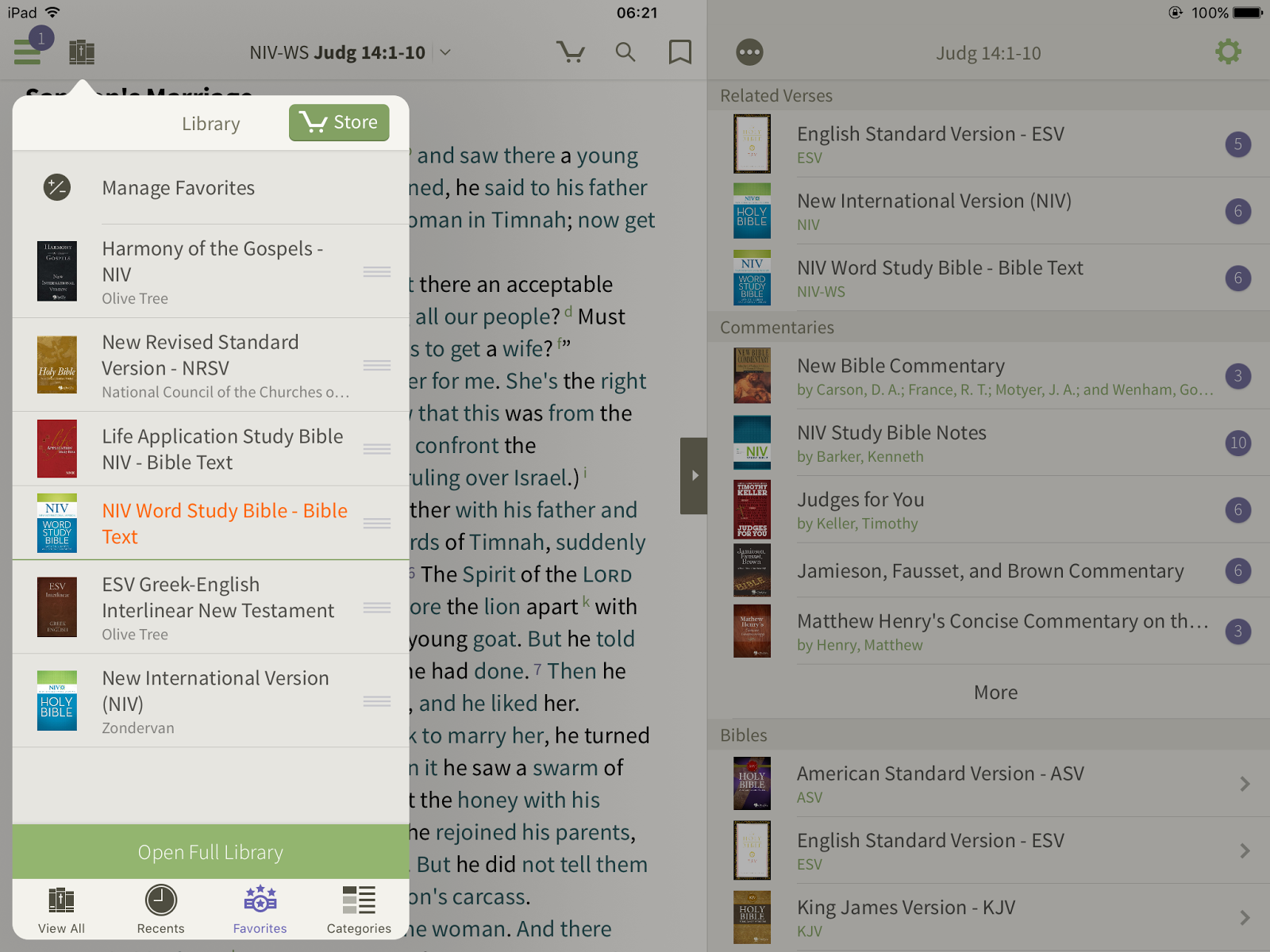
These days, computer Bible software makes this approach even easier, being able to carry around several Bibles in your pocket, on your phone. This is a screen shot from my iPad on which I use Olive Tree Bible Software making it very easy to switch between and compare versions of the same passage - as well as having easy access to study notes and commentaries.
Another helpful resource is the website Biblegateway which allows you to choose your verse and version and takes you straight there.
Again, which Bibles you actually end up with will often be a matter of personal preference.
When it comes to Bible study, I tend to use the ESV from the more literal end of the spectrum, the NRSV and the NIV from nearer the middle, and the Good News or Message from the paraphrase end.
I hope that helps shed a little light on why there are so many different versions and which ones to use when.
Subscribe to:
Posts (Atom)