Showing posts with label Bible. Show all posts

Thursday, 25 January 2018

Your most valued possession?

I wonder what your most valued possession is? Not necessarily that thing that you own that is worth the most money, but what is most precious to you? What would you grab first if you had to evacuate your home because of a fire?

I doubt many of us would say a Bible. Even though a familiar Bible may have meaningful scribbles and notes in the margin and although we don't know exactly where that verse in Ephesians is - we do know that it's in the bottom half of the left-hand page - but a Bible is easy to replace - at least in terms of the text. 


This afternoon at Oasis Tea we're going to be looking at the story of Mary Jones. Mary was born in Wales in 1784. Every Sunday her family would make the two-mile trip to church and Mary soon fell in love with the Bible, its stories and the God it spoke of. By the age of 9 Mary was determined to have a Welsh language Bible of her own. Mary's family were poor and Welsh Bibles were rare and expensive but Mary was determined. So she started to save up for her very own Welsh Bible. 

After six years she had enough money and set off on foot on the 25 mile trip to Bala in order to buy a Bible for herself.

The man she finally bought her Bible from was so inspired by her story that he went on to found the organisation that is now the Bible Society. You'll find their website here which includes more details of Mary's story.

The Bible Society are passionate about providing people with affordable copies of God's word in their own language. Here's a video of the excitement from a tribe in West Papua who have waited 47 years for the New Testament in their own language.


I wonder how much we take having a copy of God's word available in a language that we can read for granted. We've never had such easy, instant access to God's word and yet I wonder if we read it and value it less than generations before us.

It wouldn't be Oasis Tea without a little craft to entertain and frustrate. Mary Jones' father was a weaver, as to was her husband, and so we're going to weave a simple bookmark - maybe to use in a Bible.


You'll need three drinking straws, these are about 12cm long, and three pieces of wool (about 6 cm longer than your straws) tied together at one end and threaded through the straws. Finally, use a piece of tape to fix the staws together at the knotted end.

You're now ready to start weaving.

Take the piece of wool you want to start weaving with and tie it to one of the outside straws. (This piece is not one of the three pieces you've threaded through the straws.)


Then simply start weaving - over, under, over, under...


Make sure you keep your wool reasonably tight and pressed up towards the knot end. If you want to change colour just tie another colour on and tuck any loose ends into the weaving.

Keep going until you get to the end of the straws and tie off your wool to one of the outside straws.
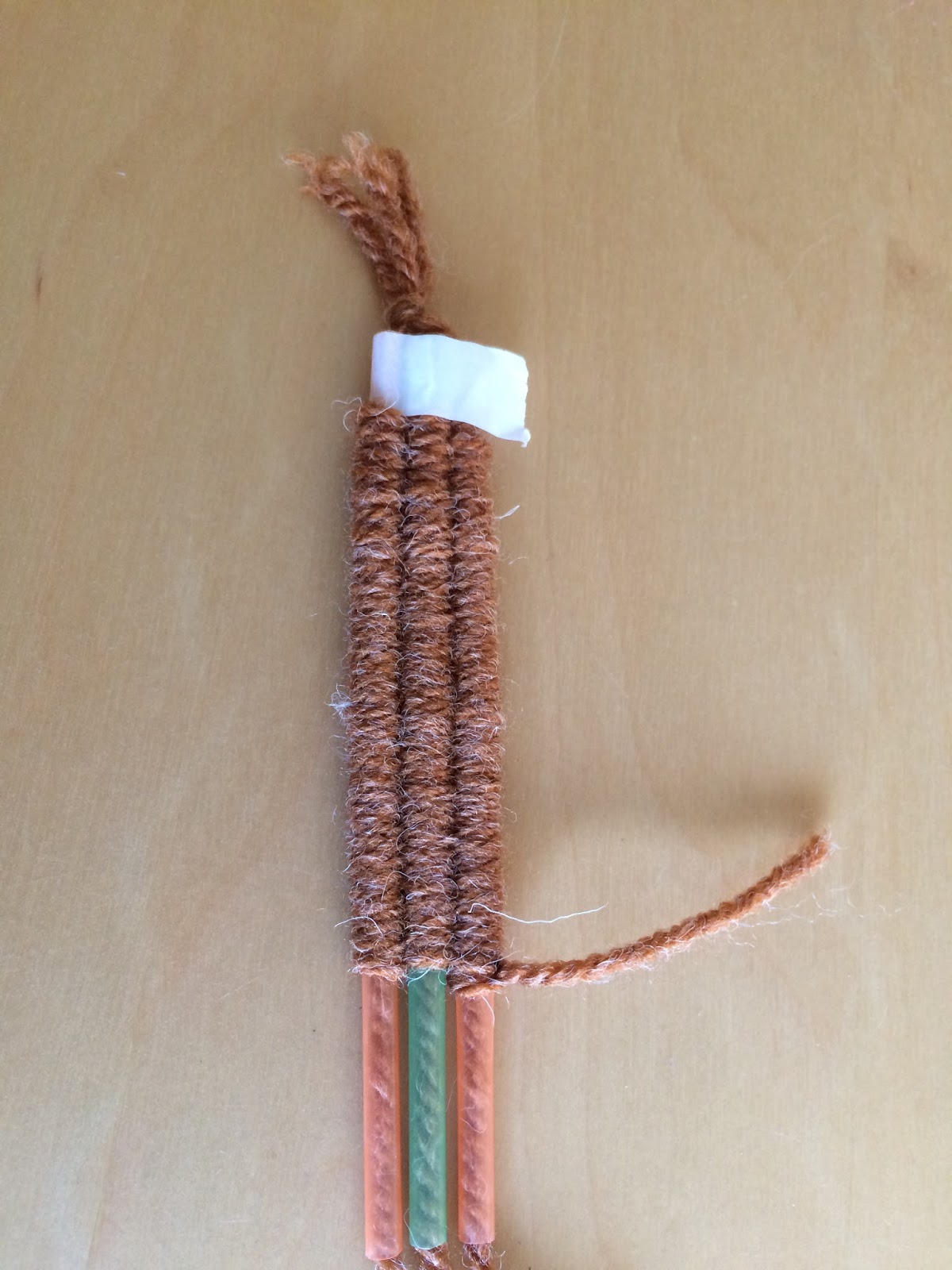

Now, carefully remove the tape and whilst holding your weaving in one hand carefully pull out the straws one at a time.


Once you've removed the staws tie the three long threads together. You can now move your weaving up and down the strings to get them into the position that you like. Trim off any loose ends.


Obviously, you can make your weaving longer by using longer straws or by pulling your straws down your weaving as you progress. You can make your weaving wider by using more straws.

Tuesday, 7 March 2017

Bible Study Resources

On Sunday at CBC we were talking about being biblical - and one of the things I said was that none of the Bible was written with us in mind. So when Paul was writing the letter to the Galatians he was not thinking about the Christians at CBC. 

And I specifically mentioned a verse that is often quoted, Jeremiah 29:11, "for I know the plans I have for you," declares the Lord, "plans to prosper you and not to harm you, plans to give you hope and a future". Maybe I should say I mentioned a verse that is often misquoted - because Jeremiah wrote these words to the exiles in Babylon - not to the Christians at CBC.

My point was not that none of the Bible was written to us and therefore it doesn't apply or isn't relevant. 

Part of what it means to be biblical is that we believe that the Bible is the inspired Word of God, that it is a living word, and that it is relevant and speaks today through the Holy Spirit.

My point was that therefore we always need to go through a process of interpretation. That's obvious when we read a verse where it is clear that the biblical context is far removed from our context - say, a verse in Leviticus about not wearing clothes made from two types of material. But it is not always so obvious when we read a verse like Jeremiah 29:11. 

There are two main stages in this process of interpretation.

The first is to work out the meaning of the text in its original context - what did it mean then. The technical term for this stage in the process is 'exegesis'.

Once that's done we then ask God to show us how that applies in our situation - what does it mean now. This part of the process is called 'hermeneutics'.

On Sunday I mentioned some additional resources that can help us with the first part of this process. This first part in this process involves knowing something about the historical context about when a passage was written. We need to know something about the literary context - part of this involves reading more than just one verse - but unless you know Hebrew, Greek and Aramaic you are probably going to need some help here too. And then we're going to need some help understanding unfamiliar words.

Alongside the Holy Spirit and prayer, a good friend or home group and a good Bible translation the following are useful resources.

A Study Bible


A good study Bible is a great place to start because alongside the Bible text you will find helpful notes that will give you a brief insight into relevant issues. Lots of study Bibles are available - I currently use the NIV Life Application Study Bible and the NIV Study Bible.

The advantage with a Study Bible is that you only need to purchase one book and everything is contained in that one volume. This saves both space and money.

One of the disadvantages is that the notes are necessarily short and brief. Another danger is that because the notes are right there on the page we go straight to someone else's notes rather than prayerfully reflecting on the text itself and listening to God.

Of course many of these resources are available online or can be purchased via various apps and computer programs. 

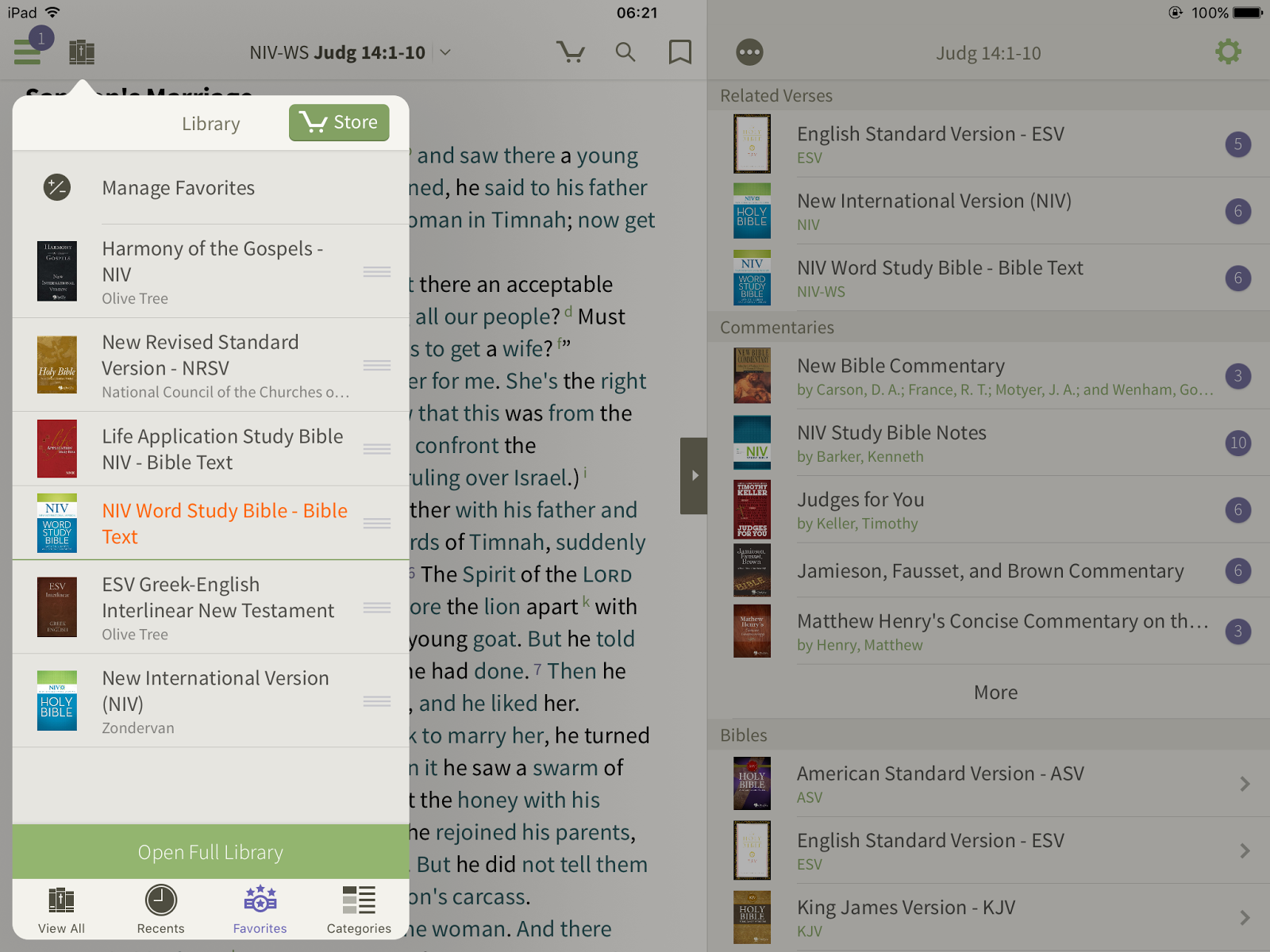
For a number of years now I have used Olive Tree Bible Software. I have this on my laptop, iPad and phone which means I can have a whole library in my pocket. Another great advantage of using this kind of software is that it quickly links a whole range of resources together around a particular verse or passage.


A Commentary

The second resource that I mentioned was a commentary. A commentary is basically a book where someone else writes about the interpretive process. So it will tell you about the historical context. The linguistic issues. The literary context. Difficult words. Many commentaries will also make an attempt at application.

There are hundreds and hundreds of different commentaries to choose from - but a single volume commentary is a good place to start - this deals with the whole Bible in one book but in a bit more detail than the Study Bible.

I use the IVP New Bible Commentary and also the Africa Bible Commentary - which is written from an African perspective for an African audience and provides some value insights that get missed when we read from a purely white, western perspective.

You might decide, maybe because you're preaching on a particular book of the Bible, that you need more information than can be provided in a single volume commentary. This is when you start to turn to specific commentaries - a whole commentary written about one book of the Bible. You won't be surprised to discover that once again there are a whole variety to choose from. I tend to use commentaries from the NIV Application Commentary series and the BST (Bible Speaks Today) series.

A Bible Dictionary

A Bible dictionary will help you with those words that you don't understand, but will also contain information about the people and places that you read about in the Bible. The main dictionary that I regularly use is the IVP New Bible Dictionary.

Obviously, there is a whole range of resources and some of them are quite expensive. So if you want to borrow or have a look at some of them just let me know.


Sunday, 4 December 2016

Which translation?

On Sunday at CBC we were looking at the story of Samson. This is quite a long story and takes up four chapters (Judges 13-16), so we didn't have time to read the whole thing. Hopefully, if you've not done so already, you'll get a chance to read the story through before home groups this week. But, be warned, it's another one of those stories that leave you wondering, 'what is this doing in the Bible?'

One of the themes of this story is to do with eyes. As with many of the stories in Judges this account begins with the comment 'Again Israel did evil in the eyes of the Lord' (Judges 13:1). 

Then in chapter 14 we find Samson seeing and wanting a young Philistine woman - he orders his dad, 'get her for me as my wife'.

But the Philistines are the enemy and the people of Israel have been commanded not to intermarry with them (e.g. Deuteronomy 7:3-4). So Samson's parents try to discourage this match - but there's no telling Samson once his eyes have seen and he's set his heart on getting. And then there is a line which the NIV translates, 'she's the right one for me' (14:3).

The ESV's translation of this verse is much closer to the original, 'she is right in my eyes'. 

What's more important for Samson? Doing what is right in God's eyes - or doing what is right in his own eyes? It is not until the end of the story when Samson has actually lost his physical eyes that he begins to see things from God's perspective (16:28).

On Sunday we had time to explore this theme of which is more important - doing what is right in God's eyes or doing what looks right in my eyes. But we did not have time to explore potential questions raised about the different translations of this verse in the NIV and ESV. So as promised, here are a few thoughts.


If you want to know a lot more on this subject my go to book is 'How to read the Bible for all its worth' by Fee and Stuart - particularly chapter 2. (I currently have two copies if anyone wants to borrow them - assuming you live locally.)

Unless you can read Hebrew, Greek and Aramaic then you're going to need a Bible translated into a language you can read. When it comes to English Bibles there are lots to choose from - so which one is best?

Well, the answer to that question very much depends on what you want it for.

You might think that a literal, 'word for word' translation would be best. But if you've studied another language you will be aware that sentence structure and word order are not always the same as they are in English. Also, words do not always translate simply into another word. And figures of speech that were commonplace and understood in First Century Jerusalem simply make no sense to us today. So whilst such a translation might be faithful to the literal text it may be difficult to read (particularly out loud) and hard to understand.

Another approach taken to Bible translation is therefore 'thought for thought' rather than 'word for word'. This approach looks to communicate the meaning of the original but is not restricted to use the original words. These versions are often easier to read and understand, but sometimes mean that we miss links (such as the use of 'eye' in Judges 13:1 and 14:3).

(Sometimes 'word for word' and 'thought for thought' are called 'formal equivalence' and 'dynamic equivalence' respectively.)

At the opposite end of the spectrum to 'word for word' is the paraphrase. This is very much about telling the overarching story and takes 'thought for thought' to the extreme in that there is very little evidence of the original words or sentence structure in the text. You see this, for example, in the Message, where it is not possible to include verse numbers in the text because the meaning is communicated over a paragraph.

There are many different Bible translations in the English language and they will all fall somewhere on this spectrum. You'll find many charts and diagrams on the internet - here's one from the Olive Tree Blog.


The Bible that a person may choose is often a matter a personal preference and one that you grew up with. Personally, I use the NIV as my 'everyday' Bible. 

But, as was demonstrated above, with Judges 14:3, when it comes to Bible study - whether this is personal study (as opposed to devotional daily reading), or preparation for a Bible Study or sermon - it is good to use more than one version - each from a different part of the spectrum. 


These days, computer Bible software makes this approach even easier, being able to carry around several Bibles in your pocket, on your phone. This is a screen shot from my iPad on which I use Olive Tree Bible Software making it very easy to switch between and compare versions of the same passage - as well as having easy access to study notes and commentaries.

Another helpful resource is the website Biblegateway which allows you to choose your verse and version and takes you straight there.

Again, which Bibles you actually end up with will often be a matter of personal preference.

When it comes to Bible study, I tend to use the ESV from the more literal end of the spectrum, the NRSV and the NIV from nearer the middle, and the Good News or Message from the paraphrase end.

I hope that helps shed a little light on why there are so many different versions and which ones to use when.

Friday, 1 April 2016

Why you shouldn't do everything you read in the Bible


At CBC our Vision helps us understand where we are headed and our seven Core Values shape everything that we do and say.

We started to think a bit more about these Core Values a couple of weeks ago - if you missed these posts then use the links below to catch up.

Our Core ValuesLovingWelcoming, Missional, Servant-hearted, Biblical, Spirit-led and Prayerful

This week I want to think about what we mean when we say that we're biblical and what that looks like in practice.

Broadly speaking I guess most of us mean that we believe the Bible and that what we do is governed by what we read in the Bible. The trouble is is that it's not quite as simple as that. We don't do everything that's written in the Bible. 


There are parts of the Old Testament that we would say are cultural and therefore do not apply to us any longer - the question then becomes: how do you decide which bits apply and which bits don't and on what basis do you make that call?

So for example, there will be those who say that it is wrong for a Christian to have a tattoo - and they would base this on Leviticus 19:28. But these same people are happy to ignore another verse earlier in the same chapter verse 19 by wearing clothes that are made of mixed fibres.

And things are not always any easier in the New Testament. Here at CBC we have women in leadership, we have women preachers. Within the Baptist Union we have women ministers. The General Secretary of the Baptist Union is currently a woman. And yet doesn't Paul quite clearly say that this should not be the case in places like 1 Corinthians 14:34?

So what do we mean when we say that we are biblical?

Firstly we recognise that the Bible was written under the inspiration of the Holy Spirit and within its pages we read the story of God and his interaction with men and women throughout history. Therefore when we read the Bible we discover God and find out what he is like.

And although the Bible is divided into two main parts, as well as containing lots of smaller books, it contains one overarching story - and therefore all those smaller parts have to be read and understood within the context of the single overarching story.

At the heart of this story we find Jesus - and the events of the first Easter - the cross and the empty grave. And therefore we learn to read the rest of the story from the perspective of the cross and the empty grave - but also bearing in mind that this story has a beginning and it has an end.

We also appreciate that the times in which we now live are very different to the times when the Bible was written - and therefore all of the Bible is cultural (and not just bits about tattoos or wearing clothes made of two kinds of fibre). And therefore it is never simply the case that we do something because it is written in the Bible.

So when we read the Bible we need to understand first of all what it was saying then - and then ask God to help us answer the question, "if that's what it said then - what is it saying to me now?" So - why is it that Israel were not allowed tattoos? Is it something to do with the practices of the nations around them? And if so why did they have to be different? Are there any similar issues that apply today (which may or may not have anything to do with tattoos)?

Because the Bible is the story of God it is important that we read it. Not just in church on a Sunday but daily - asking God to speak to us as we do so. This is not always easy and there are all kinds of things that can easily get in the way of this discipline.


A number of us here at CBC have committed to reading through the whole of the Bible this year - following the Read Scripture plan from the great people at the Join the Bible Project. One of the great things about this scheme is that at the beginning of every new book, and at various other points along the way they have short (7-8 minute) videos that help explain the book, and provide pointers in understanding what you're reading. You can find out more by visiting their website here.

If you're looking for a book to help you understand and read the Bible I'd highly recommend these two:

How to read the Bible for all its worth and How to read the Bible book by book.


Tuesday, 13 September 2011

Why Christians should not wear polyester

Between now and Christmas we're going to be looking at a range of issues/topics/questions on Sunday mornings that people have raised and expressed an interest in. Some of these issues come out of our Bible reading - such as The End Times; others come out of our daily lives - such as Work or Relationships (two separate topics - not a choice that has to be made!)

Because we are going to be tackling these questions from a Christian perspective we are going to be using the Bible - but that raises a whole range of other questions.

It is not simply a case of reading the Bible and doing what it says. Because there are some things in the Bible that we do obey - such as the command not to lie or steal in Leviticus 19. But there are other things that we are largely agreed on no longer apply - such as the command not to wear clothes made of two different types of material, which is also in Leviticus 19. But who gets to say what things apply and what things don't? When do we allow growing trends within society to challenge an 'out-of-date' teaching - such as slavery or the role of women in the church?

And how/what do we think about the Bible? What kind of book is it? What do we mean when we say that the Bible has authority?

I don't think we read the Bible in order to find verses to give easy answers to the questions we wrestle with. Rather we immerse ourselves in the story about God, in order that we encounter God in the story, and through engaging with that story, we learn how to live in the present - in a way that is innovative and yet consistent with what we find there.

Our first topic, for next week, is Decision Making and the Will of God.

Thursday, 21 January 2010

Mobile Phone or Bible?


Here's something I came across the other day...

Ever wonder what would happen if we treated our Bible like we treat our mobile phone?

What if we carried it around in our bags or pockets?

What if we flipped through it several times a day?

What if we turned back to go get it if we left it at home?

What if we used it to receive messages from the text?

What if we treated it like we couldn’t live without it?

What if we gave it to our children as a gift?

What if we used it when we travelled?

What if we used it in case of emergency?

This is something to make you go…..hmm……. where is my Bible?

Oh, and one more thing. Unlike our mobile phone, we don’t have to worry about our Bible being disconnected, out of battery, or somewhere where there is no signal because Jesus already paid the bill, and the power and the signal come from the Holy Spirit.

Makes you stop and think ‘where are my priorities?

Trust in the Lord and *ASAP (Always Say A Prayer)

Saturday, 11 July 2009

Codex Sinaiticus


Have you ever wondered what one of the oldest Christian Bibles looks like. Codex Sinaiticus was handwritten well over 1600 years ago, and the manuscript contains the Christian Bible in Greek, including the oldest complete copy of the New Testament. And now it is available online at http://www.codex-sinaiticus.net/

You may be interested to take a look even if you don't understand a word of Greek.