On Sunday we watched a few videos - which don't come across well with the audio recording of the service. So you'll find them below.
I expect that most of us know what it is like to wear a mask - to be one thing on the outside whilst knowing that inside things are very different.
Last Sunday at CBC, as part of our series, 'Jesus is good news' we were looking at Mark 7:1-23. We have already seen that Jesus knows what people are thinking - he sees what's going on on the inside as well as what's going on on the outside.
One of the challenges of Jesus' teaching is that ultimately it’s not, what we do that matters, but why we do it. What people see on the outside is not as important as what God sees on the inside. So even if we're doing lots of good stuff, if our motives are wrong, it ultimately counts for nothing.
The things that we do need to come out of a heart that is responding to what God has already done. We've already seen in this series that God can deal with our sin problem - we can't fix that ourselves no matter how much good stuff we might do. We need to let God deal with our sin problem first, and then act in response to God's love for us.
For Jesus, everything stems from our total love for God and our love for those around us. Jesus was calling his disciples into a relationship - a relationship with God which would impact their relationship with others (Mark 12:29-31).
But how much of what we do is just tradition - and is that necessarily a bad thing?
Jaroslav Pelikan said, ‘Tradition is the living faith of the dead, traditionalism is the dead faith of the living.’
It can be very easy to read a passage like Mark 7 and be critical of the Pharisees; to conclude that tradition is bad; to be totally oblivious to our various traditions; to throw the baby out with the bath water.
There certainly seem to be fewer traditions telling us about how to behave on a Sunday than there were when I was growing up. All sorts of things that you could and (mainly) could not do on a Sunday.
But traditions can be good.
Some traditions act as a signpost - pointing us toward God and what God is like. The ceremonial washing reminds us that God is holy and that we're not and that you can't just waltz into God's presence. This points to a truth about God, but also points us towards Jesus - the one who will provide the way in which we can be made clean and therefore free to enter God's presence. The problem occurs when the signpost becomes more important than what it is pointing towards.
Other traditions act as a fence keeping us away from the edge of a dangerous cliff. They keep us from putting ourselves in a situation or a place where we are likely to sin, or where we put ourselves in a spiritually dangerous place.
Some traditions are important because they help us develop the disciplines that keep our relationship with God healthy.
Are there traditions that you stick to? Why? What are they helping you to do?
Are there traditions that you might need to pick up again or start for the first time - things that will help you in your walk with God?
Tuesday, 27 February 2018

Friday, 2 February 2018
What are you doing for Lent this year?
Within two weeks we'll be into the Christian season of Lent. Depending on your church tradition and background this will be more or less of a 'thing'. As I've mentioned on here before, I grew up going to church twice every week but would never have acknowledged Lent - although pancakes definitely were a 'thing'. Lent is not mentioned in the Bible. The disciples would not have observed Lent. So what is it all about?

Lent is the time in the church calendar that runs from Ash Wednesday (this year that's the 14th of February) through to Easter Day (which is Sunday 1 April 2018). Traditionally Lent is the period of preparation in the run-up to the events of Easter - the crucifixion and resurrection of Jesus. A time of reflection and repentance - which in certain church traditions is often accompanied by fasting. It is also identified with Jesus' 40 days in the wilderness during which time he fasted (e.g. Matthew 4:1-11)
Lent lasts for 40 days but if you've looked at a calendar you will have noticed that there are actually 46 days between Ash Wednesday and Easter Sunday. That's because the six Sundays during this time do not count as days of fasting - Sundays are always a day of celebration as we remember and celebrate the resurrection.
Many people, even those with little or no church contact, will give something up for Lent - often this will be chocolate, although in recent years we have been encouraged to be a little bit more imaginative, giving up things like Facebook or television. Within some cultures it is common to go without fish for Lent. Other cultures with have different traditions. This 'doing without' builds on the fasting element that is traditionally a part of Lent.
Although I have no hard statistics to prove this, I get the sense that over recent years the observance of Lent has grown in popularity. I don't know if it's the result of the breaking down of some of the traditional barriers between different denominations; or the appearance of new and creative ways to observe Lent; or the fact that we are exposed to such a wide spectrum of ideas on Social Media - but whatever it is, you may be thinking about what you're going to do this Lent.
As well as the traditional giving something up approach many Christians are now using Lent as a spur to do something positive.
Perhaps most well known of these is 40 Acts. When you visit their website (click here) you are greeted with the message:

The challenge is to use each day of Lent to do something generous. And whether you're an individual, a church, a family, a school... there will be different ways that you can get involved and they will have the resources to help you.
Others might choose to sign up to a 40-day reading programme - maybe using an actual book, or often through an App or daily email service. If you're a regular user of Social Media then you'll probably start to see them appearing in the next few days.
I've also seen other ideas, such as a Plastic-less Lent - click here - looking to use Lent as the springboard to develop habits that are good for the environment and learn along the way. I'm sure that as Ash Wednesday approaches there will be other interesting ideas showing up on my Twitter feed each day.
Anyway, with just over a week to go until Ash Wednesday it's time to think about what I'm doing for Lent this year.

Lent is the time in the church calendar that runs from Ash Wednesday (this year that's the 14th of February) through to Easter Day (which is Sunday 1 April 2018). Traditionally Lent is the period of preparation in the run-up to the events of Easter - the crucifixion and resurrection of Jesus. A time of reflection and repentance - which in certain church traditions is often accompanied by fasting. It is also identified with Jesus' 40 days in the wilderness during which time he fasted (e.g. Matthew 4:1-11)
Lent lasts for 40 days but if you've looked at a calendar you will have noticed that there are actually 46 days between Ash Wednesday and Easter Sunday. That's because the six Sundays during this time do not count as days of fasting - Sundays are always a day of celebration as we remember and celebrate the resurrection.
Many people, even those with little or no church contact, will give something up for Lent - often this will be chocolate, although in recent years we have been encouraged to be a little bit more imaginative, giving up things like Facebook or television. Within some cultures it is common to go without fish for Lent. Other cultures with have different traditions. This 'doing without' builds on the fasting element that is traditionally a part of Lent.
Although I have no hard statistics to prove this, I get the sense that over recent years the observance of Lent has grown in popularity. I don't know if it's the result of the breaking down of some of the traditional barriers between different denominations; or the appearance of new and creative ways to observe Lent; or the fact that we are exposed to such a wide spectrum of ideas on Social Media - but whatever it is, you may be thinking about what you're going to do this Lent.
As well as the traditional giving something up approach many Christians are now using Lent as a spur to do something positive.
Perhaps most well known of these is 40 Acts. When you visit their website (click here) you are greeted with the message:

The challenge is to use each day of Lent to do something generous. And whether you're an individual, a church, a family, a school... there will be different ways that you can get involved and they will have the resources to help you.
Others might choose to sign up to a 40-day reading programme - maybe using an actual book, or often through an App or daily email service. If you're a regular user of Social Media then you'll probably start to see them appearing in the next few days.
I've also seen other ideas, such as a Plastic-less Lent - click here - looking to use Lent as the springboard to develop habits that are good for the environment and learn along the way. I'm sure that as Ash Wednesday approaches there will be other interesting ideas showing up on my Twitter feed each day.
Anyway, with just over a week to go until Ash Wednesday it's time to think about what I'm doing for Lent this year.
Thursday, 25 January 2018
Your most valued possession?
I wonder what your most valued possession is? Not necessarily that thing that you own that is worth the most money, but what is most precious to you? What would you grab first if you had to evacuate your home because of a fire?
I doubt many of us would say a Bible. Even though a familiar Bible may have meaningful scribbles and notes in the margin and although we don't know exactly where that verse in Ephesians is - we do know that it's in the bottom half of the left-hand page - but a Bible is easy to replace - at least in terms of the text.

This afternoon at Oasis Tea we're going to be looking at the story of Mary Jones. Mary was born in Wales in 1784. Every Sunday her family would make the two-mile trip to church and Mary soon fell in love with the Bible, its stories and the God it spoke of. By the age of 9 Mary was determined to have a Welsh language Bible of her own. Mary's family were poor and Welsh Bibles were rare and expensive but Mary was determined. So she started to save up for her very own Welsh Bible.
After six years she had enough money and set off on foot on the 25 mile trip to Bala in order to buy a Bible for herself.
The man she finally bought her Bible from was so inspired by her story that he went on to found the organisation that is now the Bible Society. You'll find their website here which includes more details of Mary's story.
The Bible Society are passionate about providing people with affordable copies of God's word in their own language. Here's a video of the excitement from a tribe in West Papua who have waited 47 years for the New Testament in their own language.
I wonder how much we take having a copy of God's word available in a language that we can read for granted. We've never had such easy, instant access to God's word and yet I wonder if we read it and value it less than generations before us.
It wouldn't be Oasis Tea without a little craft to entertain and frustrate. Mary Jones' father was a weaver, as to was her husband, and so we're going to weave a simple bookmark - maybe to use in a Bible.

You'll need three drinking straws, these are about 12cm long, and three pieces of wool (about 6 cm longer than your straws) tied together at one end and threaded through the straws. Finally, use a piece of tape to fix the staws together at the knotted end.
You're now ready to start weaving.
Take the piece of wool you want to start weaving with and tie it to one of the outside straws. (This piece is not one of the three pieces you've threaded through the straws.)

Then simply start weaving - over, under, over, under...

Make sure you keep your wool reasonably tight and pressed up towards the knot end. If you want to change colour just tie another colour on and tuck any loose ends into the weaving.
Keep going until you get to the end of the straws and tie off your wool to one of the outside straws.
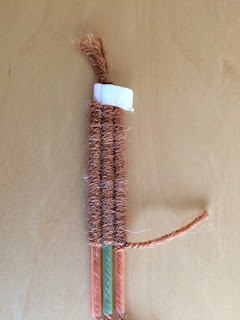
Now, carefully remove the tape and whilst holding your weaving in one hand carefully pull out the straws one at a time.

Once you've removed the staws tie the three long threads together. You can now move your weaving up and down the strings to get them into the position that you like. Trim off any loose ends.

Obviously, you can make your weaving longer by using longer straws or by pulling your straws down your weaving as you progress. You can make your weaving wider by using more straws.
I doubt many of us would say a Bible. Even though a familiar Bible may have meaningful scribbles and notes in the margin and although we don't know exactly where that verse in Ephesians is - we do know that it's in the bottom half of the left-hand page - but a Bible is easy to replace - at least in terms of the text.

This afternoon at Oasis Tea we're going to be looking at the story of Mary Jones. Mary was born in Wales in 1784. Every Sunday her family would make the two-mile trip to church and Mary soon fell in love with the Bible, its stories and the God it spoke of. By the age of 9 Mary was determined to have a Welsh language Bible of her own. Mary's family were poor and Welsh Bibles were rare and expensive but Mary was determined. So she started to save up for her very own Welsh Bible.
After six years she had enough money and set off on foot on the 25 mile trip to Bala in order to buy a Bible for herself.
The man she finally bought her Bible from was so inspired by her story that he went on to found the organisation that is now the Bible Society. You'll find their website here which includes more details of Mary's story.
The Bible Society are passionate about providing people with affordable copies of God's word in their own language. Here's a video of the excitement from a tribe in West Papua who have waited 47 years for the New Testament in their own language.
I wonder how much we take having a copy of God's word available in a language that we can read for granted. We've never had such easy, instant access to God's word and yet I wonder if we read it and value it less than generations before us.
It wouldn't be Oasis Tea without a little craft to entertain and frustrate. Mary Jones' father was a weaver, as to was her husband, and so we're going to weave a simple bookmark - maybe to use in a Bible.

You'll need three drinking straws, these are about 12cm long, and three pieces of wool (about 6 cm longer than your straws) tied together at one end and threaded through the straws. Finally, use a piece of tape to fix the staws together at the knotted end.
You're now ready to start weaving.
Take the piece of wool you want to start weaving with and tie it to one of the outside straws. (This piece is not one of the three pieces you've threaded through the straws.)

Then simply start weaving - over, under, over, under...

Make sure you keep your wool reasonably tight and pressed up towards the knot end. If you want to change colour just tie another colour on and tuck any loose ends into the weaving.
Keep going until you get to the end of the straws and tie off your wool to one of the outside straws.
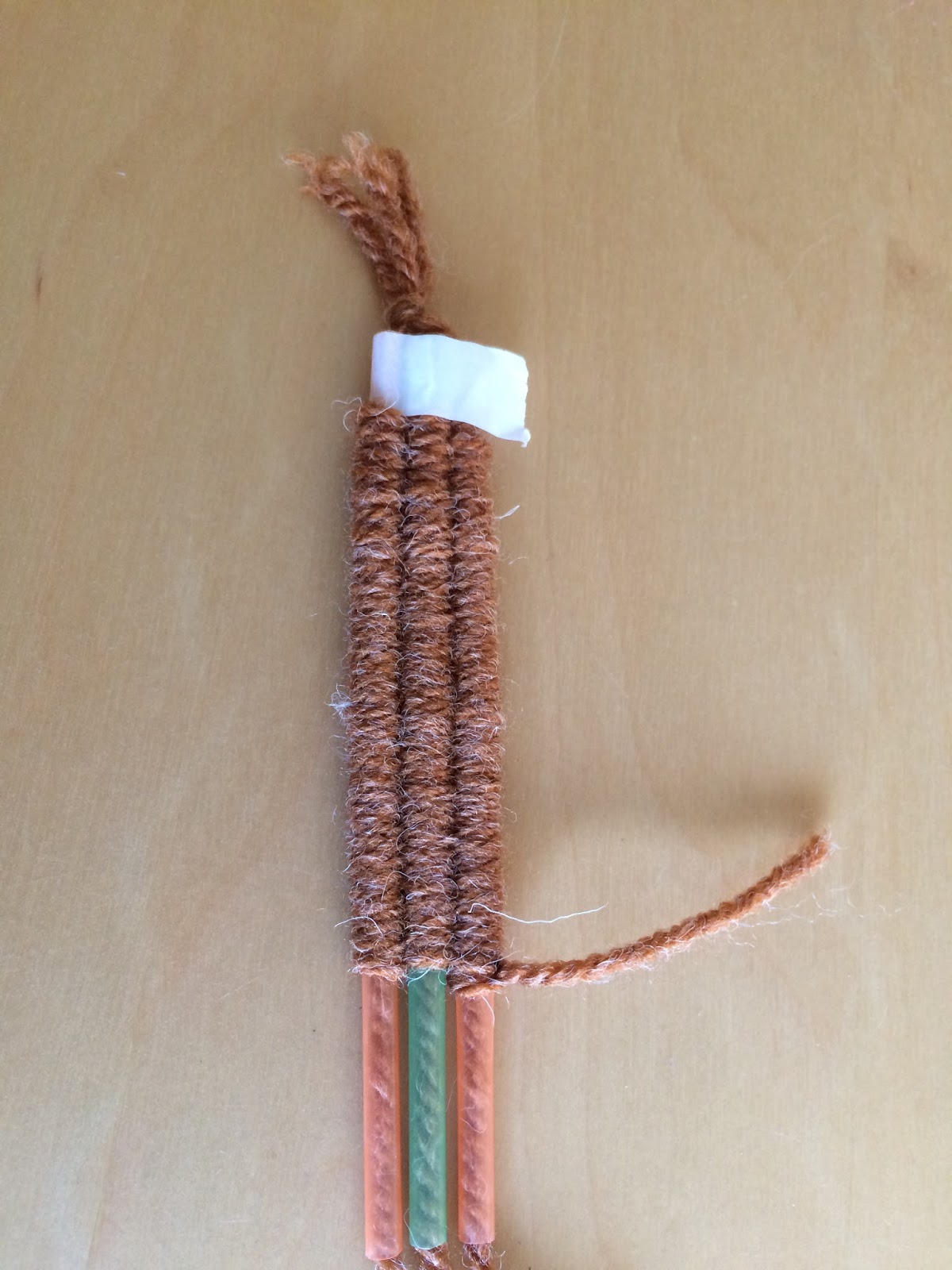
Now, carefully remove the tape and whilst holding your weaving in one hand carefully pull out the straws one at a time.

Once you've removed the staws tie the three long threads together. You can now move your weaving up and down the strings to get them into the position that you like. Trim off any loose ends.

Obviously, you can make your weaving longer by using longer straws or by pulling your straws down your weaving as you progress. You can make your weaving wider by using more straws.
Saturday, 20 January 2018
It's Good News from Rend Collective
It's very kind of Rend Collective to release their latest album 'Good News' to coincide with our latest teaching series 'Jesus is Good News'!
Here's one of the songs from the new album.
As well as some thoughts on the theme of Good News.
For more information on their album and upcoming tour (including Cambridge) visit their website here
Here's one of the songs from the new album.
As well as some thoughts on the theme of Good News.
For more information on their album and upcoming tour (including Cambridge) visit their website here
Subscribe to:
Posts (Atom)