Today at CBC we looked at the whole question of what we mean when we say that we are biblical. I appreciate that we skimmed a whole load of material with barely a mention - but some of these subjects I have blogged about before. So hopefully over the next few days I will have some time to re-blog and provide a bit more detail to a few of those bullet points.
One of the things I mentioned on Sunday was the need for a good Bible translation - but didn't go into any detail. I most recently blogged on this subject in December. What follows is largely (but not exclusively) a cut and paste from that article.
If you want to know a lot more on the subject of choosing a good Bible translation my go to book on this topic is 'How to read the Bible for all its worth' by Fee and Stuart - particularly chapter 2.
Unless you can read Hebrew, Greek and Aramaic then you're going to need a Bible translated into a language you can read. When it comes to English Bibles there are lots to choose from - so which one is best?
Well, the answer to that question very much depends on what you want it for.
You might think that a literal, 'word for word' translation would be best. But if you've studied another language you will be aware that sentence structure and word order are not always the same as they are in English. Also, words do not always translate simply into another word. And figures of speech that were commonplace and understood in First Century Jerusalem simply make no sense to us today. So whilst such a translation might be faithful to the literal text it may be difficult to read (particularly out loud) and hard to understand.
Another approach taken to Bible translation is therefore 'thought for thought' rather than 'word for word'. This approach looks to communicate the meaning of the original but is not restricted to use the original words. These versions are often easier to read and understand, but sometimes mean that we miss links (such as the use of 'eye' in Judges 13:1 and 14:3).
(Sometimes 'word for word' and 'thought for thought' are called 'formal equivalence' and 'dynamic equivalence' respectively.)
At the opposite end of the spectrum to 'word for word' is the paraphrase. This is very much about telling the overarching story and takes 'thought for thought' to the extreme in that there is very little evidence of the original words or sentence structure in the text. You see this, for example, in the Message, where it is not possible to include verse numbers in the text because the meaning is communicated over a paragraph.
There are many different Bible translations in the English language and they will all fall somewhere on this spectrum. You'll find many charts and diagrams on the internet - here's one from the Olive Tree Blog.

The Bible that a person may choose is often a matter a personal preference and one that you grew up with. Personally, I use the NIV as my 'everyday' Bible.
But when it comes to Bible study - whether this is personal study (as opposed to devotional daily reading), or preparation for a Bible Study or sermon - it is good to use more than one version - each from a different part of the spectrum.

These days, computer Bible software makes this approach even easier, being able to carry around several Bibles in your pocket, on your phone. This is a screen shot from my iPad on which I use Olive Tree Bible Software making it very easy to switch between and compare versions of the same passage - as well as having easy access to study notes and commentaries.
Another helpful resource is the website Biblegateway which allows you to choose your verse and version and takes you straight there.
Again, which Bibles you actually end up with will often be a matter of personal preference.
When it comes to Bible study, I tend to use the ESV from the more literal end of the spectrum, the NRSV and the NIV from nearer the middle, and the Good News or Message from the paraphrase end.
I hope that helps shed a little light on why there are so many different versions and which ones to use when.
Unless you can read Hebrew, Greek and Aramaic then you're going to need a Bible translated into a language you can read. When it comes to English Bibles there are lots to choose from - so which one is best?
Well, the answer to that question very much depends on what you want it for.
You might think that a literal, 'word for word' translation would be best. But if you've studied another language you will be aware that sentence structure and word order are not always the same as they are in English. Also, words do not always translate simply into another word. And figures of speech that were commonplace and understood in First Century Jerusalem simply make no sense to us today. So whilst such a translation might be faithful to the literal text it may be difficult to read (particularly out loud) and hard to understand.
Another approach taken to Bible translation is therefore 'thought for thought' rather than 'word for word'. This approach looks to communicate the meaning of the original but is not restricted to use the original words. These versions are often easier to read and understand, but sometimes mean that we miss links (such as the use of 'eye' in Judges 13:1 and 14:3).
(Sometimes 'word for word' and 'thought for thought' are called 'formal equivalence' and 'dynamic equivalence' respectively.)
At the opposite end of the spectrum to 'word for word' is the paraphrase. This is very much about telling the overarching story and takes 'thought for thought' to the extreme in that there is very little evidence of the original words or sentence structure in the text. You see this, for example, in the Message, where it is not possible to include verse numbers in the text because the meaning is communicated over a paragraph.
There are many different Bible translations in the English language and they will all fall somewhere on this spectrum. You'll find many charts and diagrams on the internet - here's one from the Olive Tree Blog.

The Bible that a person may choose is often a matter a personal preference and one that you grew up with. Personally, I use the NIV as my 'everyday' Bible.
But when it comes to Bible study - whether this is personal study (as opposed to devotional daily reading), or preparation for a Bible Study or sermon - it is good to use more than one version - each from a different part of the spectrum.
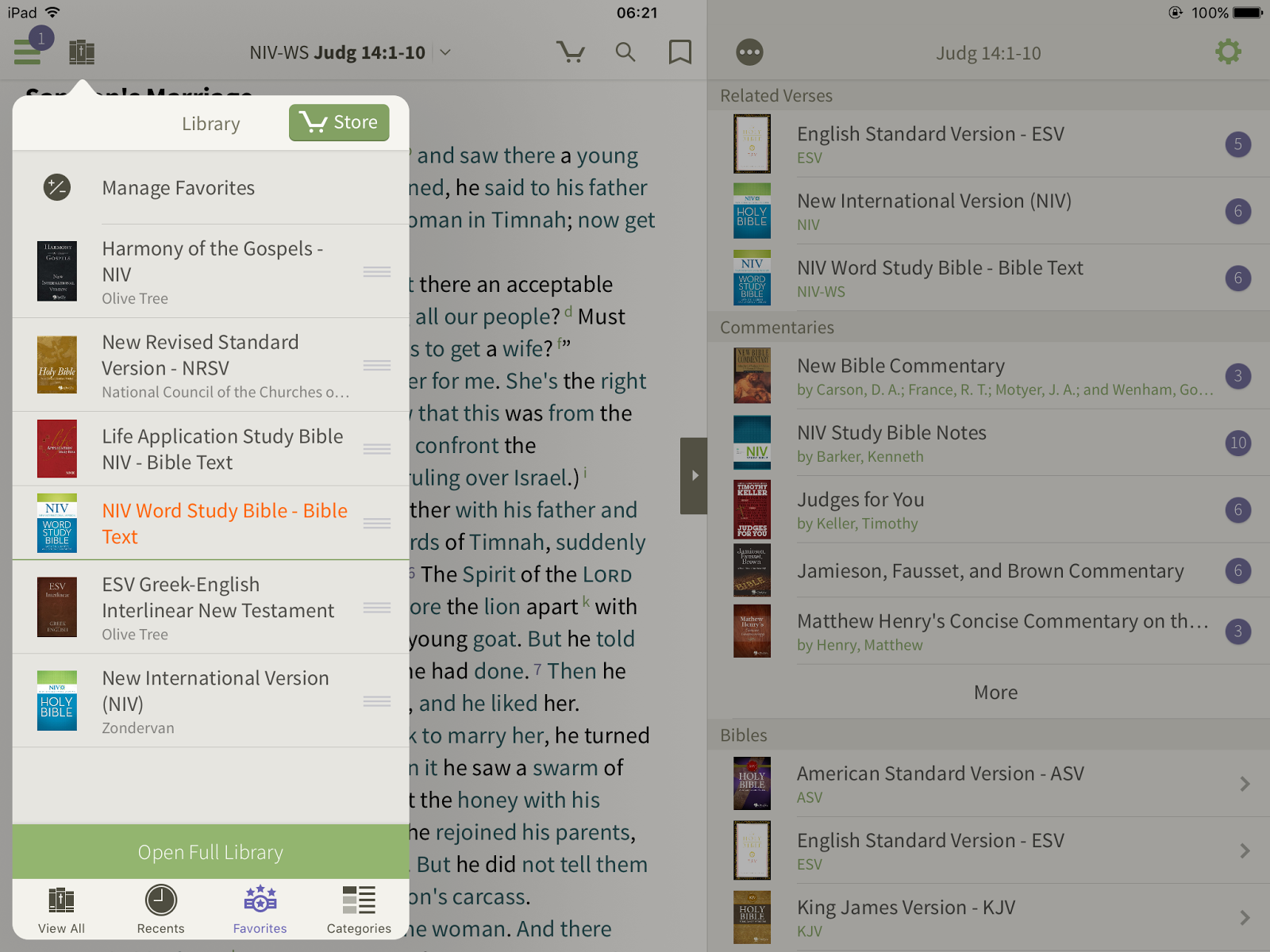
These days, computer Bible software makes this approach even easier, being able to carry around several Bibles in your pocket, on your phone. This is a screen shot from my iPad on which I use Olive Tree Bible Software making it very easy to switch between and compare versions of the same passage - as well as having easy access to study notes and commentaries.
Another helpful resource is the website Biblegateway which allows you to choose your verse and version and takes you straight there.
Again, which Bibles you actually end up with will often be a matter of personal preference.
When it comes to Bible study, I tend to use the ESV from the more literal end of the spectrum, the NRSV and the NIV from nearer the middle, and the Good News or Message from the paraphrase end.
I hope that helps shed a little light on why there are so many different versions and which ones to use when.


